
(How modern tools are preventing incidents, protecting the environment, and improving operational resilience)
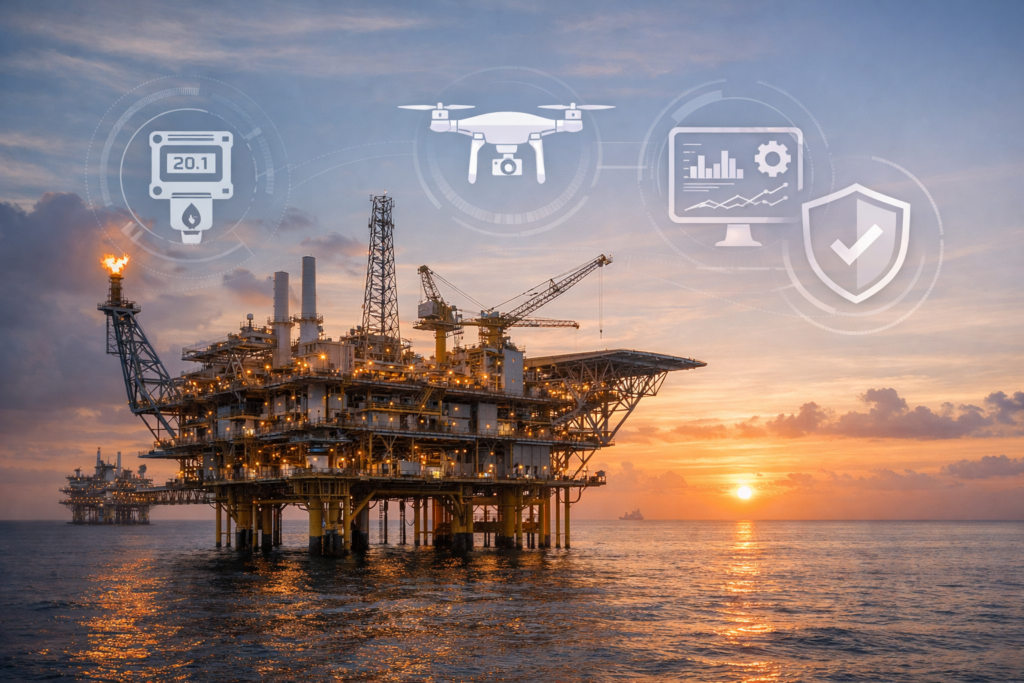
Offshore platform with digital HSSE overlay (sensors, drones, dashboards)
Technology is changing HSSE (Health, Safety, Security & Environment) in oil and gas faster than almost any other function—because it directly reduces exposure to hazards, improves decision-making, and makes high-risk work more predictable. In a sector where hazards can escalate quickly (hydrocarbons, pressure, rotating equipment, confined spaces, heavy lifts, hazardous areas, remote operations), innovation isn’t “nice to have”—it’s part of maintaining license to operate.
Below is a detailed, practical, and educative guide to the main HSSE technologies in oil & gas, how they work, where they help, and what good implementation looks like.
1) Why HSSE innovation matters in oil & gas
Oil & gas operations are complex systems with:
- High-energy hazards: pressure, temperature, moving machinery, electricity.
- Process safety risk: loss of containment, ignition, explosion, toxic release (H₂S).
- Human factors risk: fatigue, routine normalization, shortcuts under time pressure.
- Environmental sensitivity: spills, flaring emissions, produced water handling, biodiversity impacts.
- Security risks: theft, piracy, sabotage, cyber threats, civil unrest.
Technology supports HSSE by doing four big things:
- Reducing exposure (remove humans from the hazard zone)
- Detecting early (spot weak signals before escalation)
- Improving control (stronger barriers, interlocks, automation)
- Learning faster (better reporting, analytics, and feedback loops)
2) A simple HSSE technology map (barriers + lifecycle)
Think of HSSE innovation across the full lifecycle: design → build → operate → maintain → decommission, and across the “barrier model” (prevent → detect → mitigate → recover).
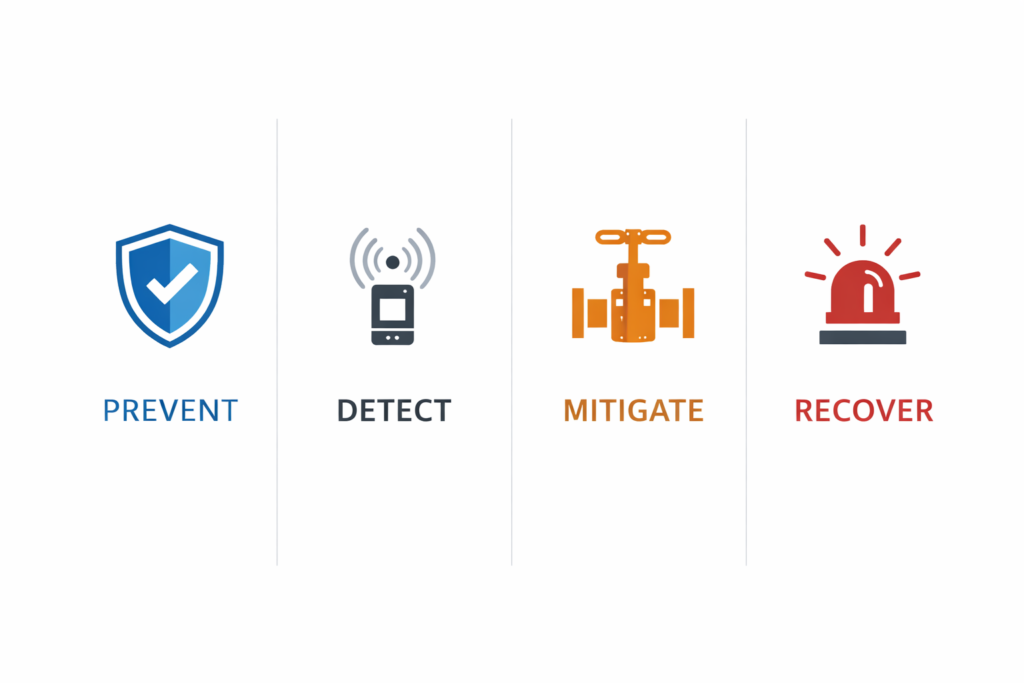
Prevent–Detect–Mitigate–Recover safety barrier model
Diagram: Barrier-based HSSE model (simplified)
flowchart LR
A[Hazard] --> B[Preventive Barriers\n(design, procedures, automation)]
B -->|if barrier fails| C[Detection\n(gas, fire, leak detection, sensors)]
C --> D[Mitigation\n(ESD, deluge, isolation, depressurization)]
D --> E[Emergency Response\n(muster, comms, rescue, medevac)]
E --> F[Recovery\n(learning, repair, restore)]
Where technology fits: everywhere—especially in prevention and detection, where early action is cheapest and safest.
3) Digital HSSE: from paper to “real-time risk”
3.1 Digital Permit to Work (ePTW) & Energy Isolation (eLOTO)
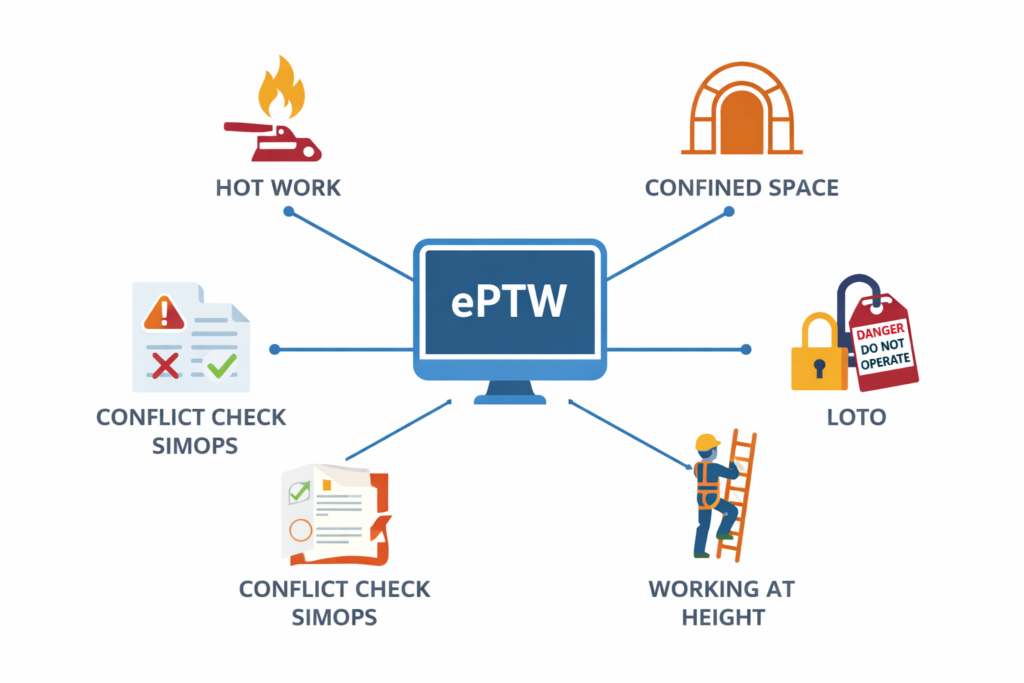
Digital permit-to-work system coordinating simultaneous jobs safely
What it solves: permit quality, simultaneous operations (SIMOPS) conflicts, verification gaps, isolation mistakes.
Typical features:
- Permit templates + mandatory fields
- Integrated risk assessment/JSA/JHA attachments
- SIMOPS conflict checks (who is working where, when)
- LOTO verification steps (tag/lock photos, sign-offs)
- Digital authorizations and time stamping
- Permit board “live view” (control room / OIM / supervisors)
Real-life example (common scenario):
A maintenance team requests a hot work permit near a process module. An ePTW system flags a conflict: another team has an open permit for breaking containment nearby. The system blocks approval until the SIMOPS risk is reviewed, controls updated, and both supervisors sign off.
HSSE impact: fewer permit errors, stronger isolations, better coordination, reduced chance of ignition during maintenance.
3.2 Digital risk assessment, observations & learning systems
What it solves: poor hazard reporting, slow learning, and repeating the same incidents.
Modern tools include:
- Mobile reporting of hazards/near misses (with photos, GPS, time)
- Simple “stop work” workflows and tracking closure
- Trend dashboards (repeat hazards by location, job type, contractor, shift)
Important: tech won’t fix a weak culture—but it can remove friction so people report faster and managers act faster.
4) Sensors, IIoT, and condition monitoring (predictive HSSE)
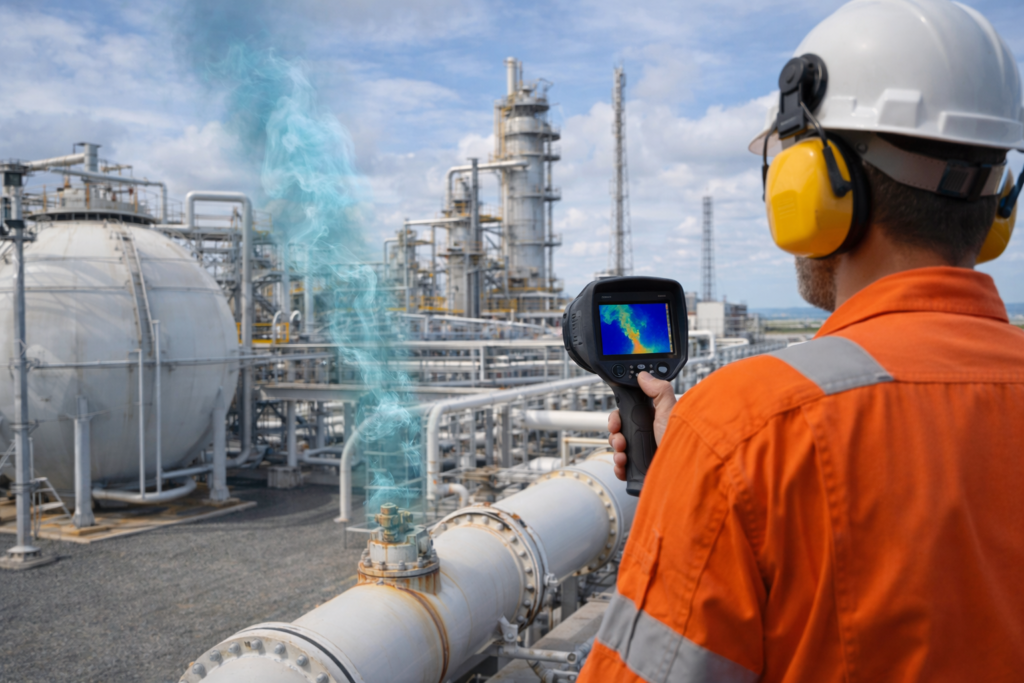
Infrared methane leak detection at gas facility
4.1 Gas, fire, and toxic detection—smarter and faster
Traditional detectors work, but modern systems add:
- Better coverage mapping
- Smart diagnostics (fault detection, drift)
- Integration into alarms, ESD logic, and incident replay
- Portable multi-gas detectors with cloud logs and compliance data
Real-life example:
Portable gas detectors upload readings automatically. HSSE notices repeated low-level H₂S peaks in a specific area during startup. Investigation finds a minor valve packing leak—fixed before it becomes a serious exposure event.
4.2 Predictive maintenance (PdM) for HSSE-critical equipment
Failures that trigger injuries or major losses often start as small signals:
- vibration changes in rotating equipment
- temperature anomalies
- pressure/flow deviations
- partial discharge in electrical systems
PdM tools: vibration sensors, infrared thermography, oil analysis, acoustic monitoring, digital twins (more below).
HSSE impact: fewer catastrophic equipment failures, fewer emergency repairs, fewer high-risk “reactive” jobs.
5) Remote operations: drones, robots, and ROVs (reducing exposure)
5.1 Drones (UAVs) for inspection and emergency reconnaissance
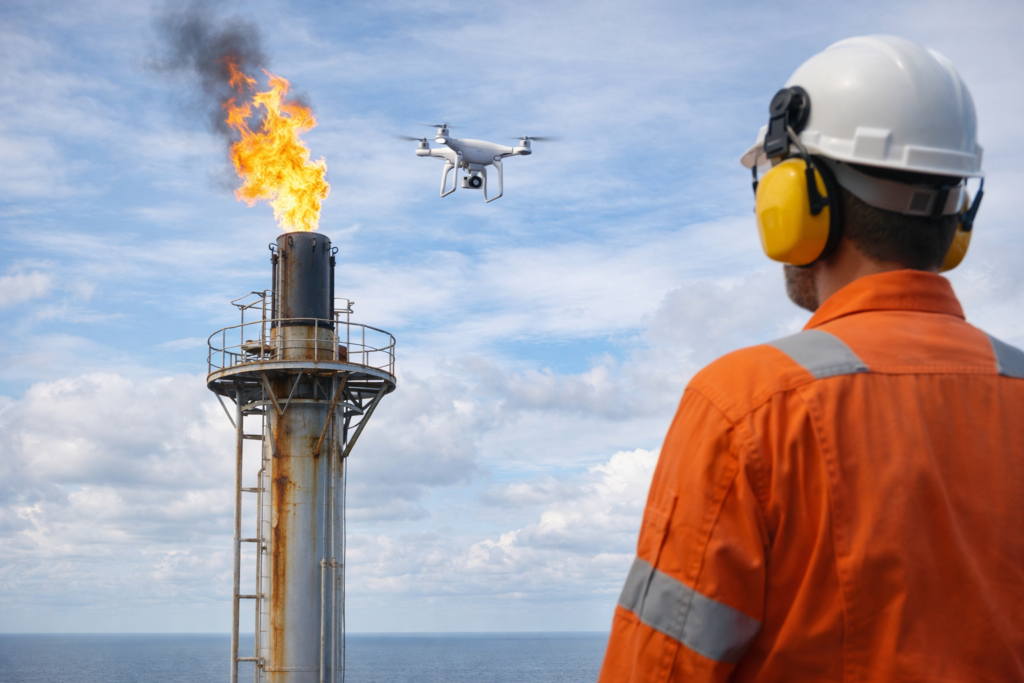
Drone inspecting flare stack to reduce work-at-height exposure
Use cases:
- flare stack inspections (visual/thermal)
- tank roof checks
- confined/unsafe area surveys after alarms
- perimeter security patrols
HSSE win: replaces work at height and reduces exposure time near hazardous areas.
5.2 Crawlers, magnetic robots, and confined-space robots
Robots can inspect:
- pipelines (corrosion mapping)
- vessel interiors
- under-deck structures offshore
- areas with poor access
5.3 ROVs (remotely operated vehicles) offshore
Used for subsea inspection, leak surveys, and structural checks without diving exposure.
6) Wearables and worker safety tech (human-centered innovation)
Wearables can support HSSE when applied carefully:
Examples:
- lone-worker man-down alerts
- location-based muster accountability
- fatigue risk indicators (used ethically and with clear policy)
- smart PPE checks (helmet detection in certain zones)
Key caution: privacy and trust matter. If workers believe wearables are for punishment, they’ll resist or bypass them. The best programs are transparent: what is measured, why, who sees it, and how it is used.
7) Process safety innovation: advanced control, SIS, and digital twins
7.1 Advanced Process Control (APC) and alarms management
Too many alarms → alarm fatigue → missed critical alarms.
Modern approaches:
- rationalized alarm philosophy
- alarm suppression rules for abnormal situations
- dynamic alarming based on operating mode
- analytics to identify nuisance alarms
7.2 Safety Instrumented Systems (SIS) improvements
Innovation isn’t always “new gadgets.” Strong SIS design includes:
- better proof testing strategies
- partial-stroke testing for shutdown valves
- improved diagnostics and lifecycle tracking
7.3 Digital twins (the game-changer when done right)
A digital twin is a living model of an asset that uses real data to simulate performance and risk.
HSSE uses:
- simulate upset conditions and safe responses
- predict corrosion hotspots and leak probability
- train operators in realistic scenarios
- test changes before applying them in the field (“safe-to-fail”)
Real-life example:
A facility uses a digital twin to model slugging in a pipeline. The twin predicts pressure surges under certain flow conditions. Operations updates procedures and control settings—reducing the likelihood of pressure excursions that could damage equipment or cause leaks.
8) Environmental innovation (E in HSSE): monitoring, emissions, and spill response
8.1 Emissions measurement and methane detection
Innovation areas:
- continuous emissions monitoring systems (CEMS)
- infrared cameras for methane leak detection
- satellite/airborne monitoring (where available)
- LDAR programs enhanced by analytics
HSSE impact: early leak discovery, better compliance, lower climate footprint, improved reputation and stakeholder trust.
8.2 Produced water and discharge monitoring
Modern sensors track:
- oil-in-water (OIW) performance
- chemical dosing optimization
- separator efficiency trends
8.3 Spill detection and response tech
- pipeline leak detection algorithms (mass balance, pressure wave analysis)
- drones/thermal imaging for spill mapping
- digital incident command systems (resource tracking, communications, logs)
9) Security innovation (S in HSSE): physical + cyber
9.1 Physical security tech
- access control and smart badges
- perimeter intrusion detection
- CCTV with analytics (used responsibly)
- drone-based patrol (in some settings)
9.2 Cybersecurity is now HSSE
Cyber incidents can become safety incidents if they affect control systems.
Key practices:
- network segmentation (IT vs OT)
- strict access control, MFA
- patching strategy for OT
- incident response drills
- vendor risk management for connected devices
Real-life example:
A contractor connects a laptop to an OT network during commissioning. A strong cybersecurity program blocks unauthorized devices and requires a controlled connection process—preventing malware or configuration changes that could impact alarms or shutdown logic.
10) AI and analytics in HSSE (powerful—but must be governed)
AI can help HSSE teams:
- predict where high-risk work is likely (based on history + conditions)
- identify recurring incident patterns
- flag weak signals (near misses + maintenance + alarms)
- auto-classify reports and recommend corrective actions
But AI must be governed:
- avoid “black box” decisions on safety-critical actions
- validate models; watch for bias (e.g., underreporting by certain teams)
- keep humans accountable—AI advises, leaders decide
- protect data privacy and worker trust
11) Common implementation mistakes (and how to avoid them)
Mistake 1: Buying tools without fixing workflows
If your PTW process is weak on paper, digitizing it just makes weak steps faster.
✅ Fix the process first, then digitize.
Mistake 2: Too much data, no action
Dashboards don’t reduce risk—actions do.
✅ Define clear triggers: “If X happens, we do Y within Z time.”
Mistake 3: Ignoring contractors and frontline users
Most high-risk work is executed by the frontline.
✅ Co-design with end users. Test in the field. Simplify UX.
Mistake 4: Privacy backlash
Wearables or tracking without trust fails.
✅ Transparent policies, worker engagement, and limited access to sensitive data.
Mistake 5: Cyber gaps in connected devices
IIoT expands attack surface.
✅ Treat cyber as a barrier. Include OT cybersecurity from day one.
12) A practical roadmap to adopt HSSE innovation
Step-by-step rollout (smart and realistic)
flowchart TD
A[Pick 1-2 high-risk pain points\n(e.g., PTW quality, gas exposure, work at height)] --> B[Define success metrics\n(TRIR is not enough: leading indicators)]
B --> C[Pilot with one asset/team]
C --> D[Train + simplify workflows]
D --> E[Measure impact + learn]
E --> F[Scale with standard + governance]
F --> G[Continuous improvement\n(audit, feedback, refresh)]
Good metrics (leading indicators):
- % permits with complete controls and attachments
- isolation verification compliance
- near-miss reporting rate + closure time
- gas detector compliance + exposure trend
- backlog reduction on safety-critical maintenance
- alarm reduction and critical alarm response performance
- LDAR findings and repair cycle time
Conclusion
Technology and innovation are reshaping HSSE in oil and gas by reducing human exposure, strengthening barriers, detecting risk earlier, improving emergency readiness, and accelerating learning. The best results come when digital tools are paired with strong fundamentals: competent people, clear procedures, healthy reporting culture, disciplined maintenance, and robust leadership.