
What is H₂S?
Hydrogen sulfide (H₂S) is a colorless, flammable, and highly toxic gas, often recognized by its characteristic rotten egg odor at low concentrations. Commonly found in industries such as oil & gas, wastewater treatment, and paper mills, H₂S becomes increasingly dangerous at higher levels due to its rapid olfactory fatigue, which can render odor-based detection unreliable. [blog.msasafety.com], [osha.gov]
Health Effects & Exposure Levels
The severity of H₂S exposure depends on concentration and duration:
- 0.01–1 ppm: “rotten egg” odor threshold
- 10–50 ppm: Eye and respiratory irritation
- 100–200 ppm: Severe irritation and potential pulmonary edema
- 300–500 ppm: Loss of consciousness
- >500 ppm: Rapid unconsciousness and can be fatal within minutes [ohse.ca], [trojansafety.com]
This infographic illustrates the progression of symptoms at different exposure levels:
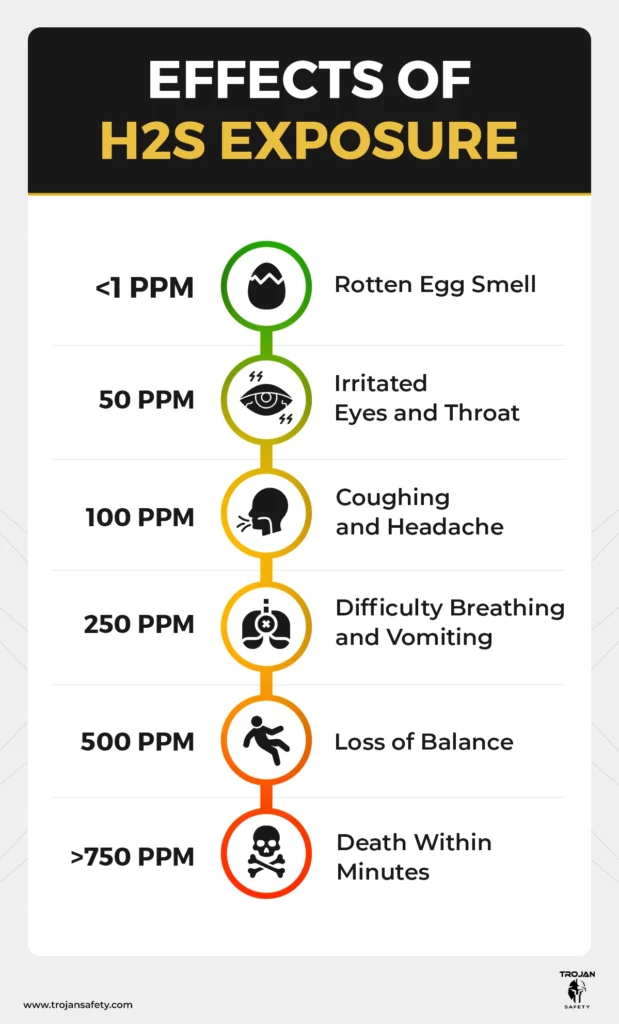
Effects of H₂S Exposure – varying ppm and symptoms [trojansafety.com]
Detection Methods
1. Fixed Gas Detectors
Installed in key areas like sewer lines or pits to continuously monitor ambient H₂S levels. [canadasafe…aining.com]
2. Personal Portable Monitors
Devices such as Ventis Pro5 and Tango TX2 provide real-time, individual-level detection—essential for confined spaces. [indsci.com], [canadasafe…aining.com]
3. Colorimetric Tubes
Manual, cost-effective tubes change color proportionally to H₂S exposure—ideal for spot checks. [liquidgasa…lyzers.com]
4. Advanced Laboratory Methods
Methods like gas chromatography, spectrophotometry, and mid-IR laser absorption offer sensitive, accurate measurements in labs. [liquidgasa…lyzers.com], [iopscience.iop.org], [indsci.com]
Detection methods overview diagram:
https://www.canadasafetytraining.com/uploads/H₂S%20Detection%20Methods.jpg
Includes fixed detectors, personal monitors, and real-time sampling methods [canadasafe…aining.com]
Regulatory Standards
- OSHA: Ceiling limit 20 ppm; Peak 50 ppm in general industries (varies by sector) [blog.msasafety.com], [osha.gov]
- NIOSH: 10-minute ceiling of 10 ppm [blog.msasafety.com], [osha.gov]
- IDLH: 100 ppm—immediate danger to life or health [ohse.ca], [osha.gov]
Engineering, Administrative & PPE Controls
- Engineering Controls
- Ventilation systems (exhaust hoods)
- Gas scrubbers (sodium hydroxide/carbonate solutions) [osha.gov]
- Administrative Controls
- Job Hazard Assessments
- Permit-to-Work systems
- Confined space protocol [osha.gov], [safetytool…topics.com]
- Personal Protective Equipment (PPE)
Monitoring & Calibration
- Routine air sampling: Continuous or pre-entry checks by qualified personnel [osha.gov], [safetytool…topics.com]
- Detector calibration: Regular zero/span adjustment with calibration gas to ensure accuracy [automation…munity.com], [instrument…ntools.com]
Emergency Response & Rescue Procedures
- Alarm response: Immediate evacuation when levels exceed safe thresholds
- Buddy system: Never work alone in areas with H₂S risk
- Rescue readiness: Trained teams equipped with lifelines, SCBA, and rescue harnesses [osha.gov]
Infographic on handling H₂S emergencies:
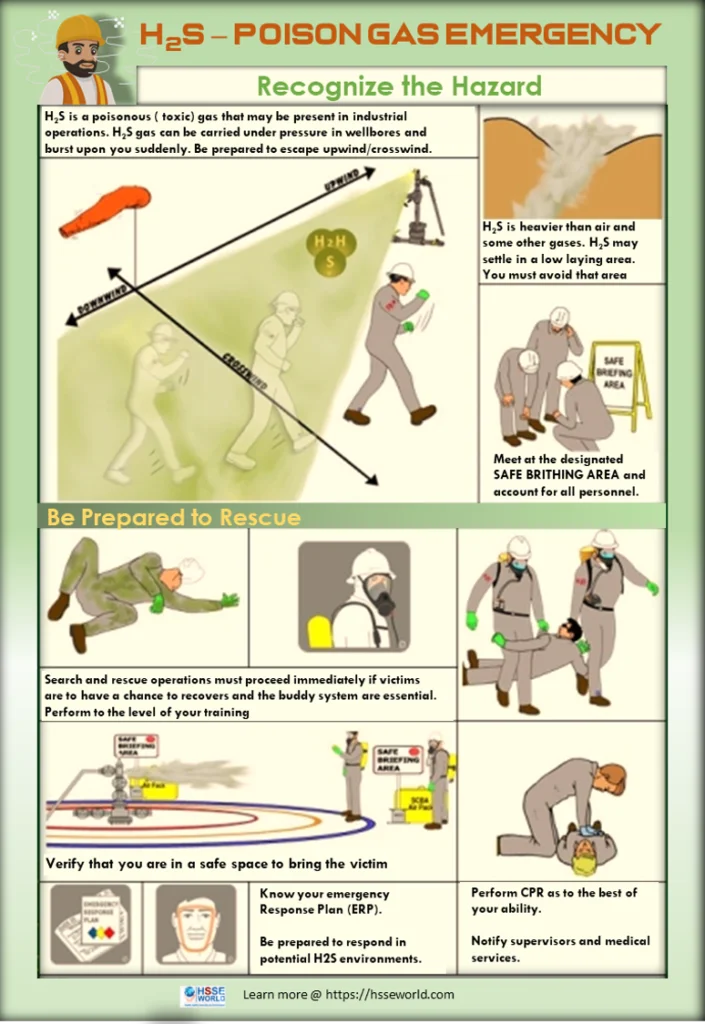
Emergency breakdown: hazard recognition, rescue prep, CPR [trojansafety.com], [hsseworld.com]
Awareness & Training Essentials
- H₂S is a “silent killer”: colorless, heavier than air, and quickly desensitizes smell [safetytool…topics.com], [blog.msasafety.com], [osha.gov]
- Train personnel on:
- H₂S properties and health effects
- Detector use and interpretation
- PPE donning, fitting, and use
- Emergency response, rescue planning, and CPR
- Stop-work authority when alarm threshold is reached [linkedin.com], [safetytool…topics.com], [osha.gov]
Recommended Training Videos
🎥 Hydrogen Sulfide (H2S) Awareness Training with Rescue
Safety Unlimited, Inc. (2:22 min): Covers recognition, rescue planning, and emergency execution.
🎥 H2S Safety Training Video
Explores properties, exposure limits, monitoring, PPE, and emergency procedures in detail.
🎥 Workplace Safety: H2S Safety Refresher
Comprehensive coverage—traits, exposure effects, rescue.
Conclusion
Awareness, robust detection systems, proper controls, and regular training form the cornerstone of H₂S safety. Understanding its silent, deceptive nature, and preparing through drills, monitoring, and compliance with regulatory standards ensures that workers remain protected. In environments like oil platforms, wastewater plants, or confined spaces, vigilance and preparedness can save lives.