
1. Introduction
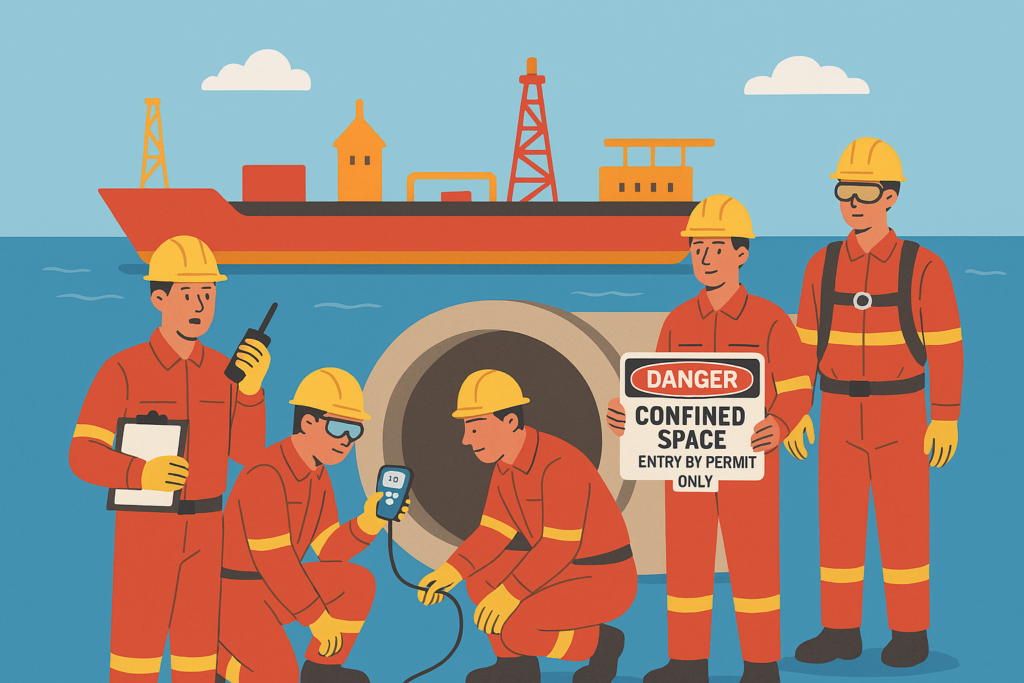
Confined spaces on FPSOs include tanks, pump rooms, void spaces, and enclosed compartments. These areas pose significant hazards such as oxygen deficiency, toxic gases, flammable atmospheres, and restricted access. Proper training and adherence to procedures are essential to prevent fatalities and injuries.
2. What is a Confined Space?
A confined space is any area that:
- Is large enough for a person to enter and perform work.
- Has limited or restricted means of entry or exit.
- Is not designed for continuous occupancy.
Examples on FPSOs:
- Cargo tanks
- Ballast tanks
- Pump rooms
- Cofferdams
- Engine rooms during shutdown
3. Hazards in Confined Spaces
- Atmospheric Hazards:
- Oxygen deficiency (<19.5%)
- Oxygen enrichment (>23.5%)
- Toxic gases (H₂S, CO, VOCs)
- Flammable vapors
- Physical Hazards:
- Heat stress
- Noise
- Slips, trips, and falls
- Operational Hazards:
- Moving machinery
- Residual hydrocarbons
- Electrical hazards
4. Roles and Responsibilities
- Entry Supervisor:
- Ensures permit is issued and conditions are safe.
- Authorized Entrant:
- Follows procedures, wears PPE, and communicates.
- Attendant (Standby):
- Monitors entrants, maintains communication, initiates rescue if needed.
- Rescue Team:
- Trained and equipped for confined space rescue.
5. Confined Space Entry Procedures
Step 1: Pre-Entry Preparation
- Identify confined space and hazards.
- Conduct risk assessment.
- Isolate energy sources (LOTO – Lock Out Tag Out).
- Ventilate the space.
Step 2: Atmospheric Testing
- Test for:
- Oxygen level
- Flammable gases (LEL)
- Toxic gases
- Continuous monitoring during entry.
Step 3: Permit-to-Work
- Obtain a Confined Space Entry Permit.
- Verify:
- Isolation completed
- Gas testing results
- Rescue plan in place
Step 4: PPE and Equipment
- Mandatory PPE:
- Helmet, gloves, coveralls, safety boots
- Additional:
- Respiratory protection (SCBA if required)
- Gas detectors
- Communication devices
- Harness and lifeline
Step 5: Entry and Monitoring
- Entrant signs in.
- Attendant remains outside.
- Maintain communication.
- Monitor atmosphere continuously.
Step 6: Exit and Close-Out
- Entrant signs out.
- Cancel permit.
- Restore equipment and isolation.
6. Emergency Response
- Rescue Plan must be in place before entry.
- Never attempt unplanned rescue without PPE.
- Use trained rescue team with SCBA and retrieval systems.
- Notify control room immediately.
7. Best Practices
- Never bypass gas testing.
- Always ventilate before and during entry.
- Keep rescue equipment ready.
- Conduct toolbox talks before entry.
- Stop work if conditions change.
8. References & Downloads
- OSHA 29 CFR 1910.146 – Permit-Required Confined Spaces
- IMO Guidelines for FPSO Safety
- Company HSE Procedures
- Download a copy of Confined Space Safety Training for FPSO Personnel (PDF)