
A comprehensive, practical, and industry-aligned guide
1. Introduction: Why Risk Management Is Central to HSSE in Oil & Gas
The oil and gas industry operates in one of the highest-risk industrial environments in the world. Activities such as drilling, production, lifting operations, confined space entry, hot work, and marine operations expose personnel, assets, the environment, and company reputation to major accident hazards (MAHs).
Risk management in Health, Safety, Security, and Environment (HSSE) is therefore not optional—it is the backbone of safe, compliant, and sustainable operations. Effective HSSE risk management ensures:
- Prevention of fatalities and serious injuries
- Protection of the environment and host communities
- Asset integrity and business continuity
- Regulatory compliance and social license to operate
In oil and gas, risk management is systematic, documented, and continuous, embedded into daily operations and strategic decision-making.
2. Understanding Risk in HSSE Context
In HSSE, risk is commonly defined as:
Risk = Likelihood × Consequence
- Likelihood – the probability that a hazardous event will occur
- Consequence – the severity of harm to people, environment, assets, or reputation
Types of HSSE Risks in Oil & Gas
- Health risks – exposure to chemicals (H₂S, benzene), noise, vibration, radiation
- Safety risks – fires, explosions, dropped objects, blowouts, collisions
- Security risks – piracy, sabotage, theft, terrorism, civil unrest
- Environmental risks – oil spills, gas flaring, produced water discharge
3. The HSSE Risk Management Lifecycle
Oil and gas companies typically follow a structured risk management cycle aligned with ISO 31000 and industry frameworks such as IOGP.
Step 1: Hazard Identification
Systematically identify anything with the potential to cause harm.
Common sources:
- Process operations (pressure, temperature, hydrocarbons)
- Tasks and activities (maintenance, lifting, confined space)
- External threats (weather, security, logistics)
Step 2: Risk Assessment
Evaluate:
- How likely is the hazard to cause harm?
- How severe would the impact be?
Step 3: Risk Control
Apply controls using the Hierarchy of Controls:
- Elimination
- Substitution
- Engineering controls
- Administrative controls
- Personal Protective Equipment (PPE)
Step 4: Monitoring & Review
- Verify effectiveness of controls
- Capture lessons learnt.
- Update risk assessments after changes or incidents
4. Key HSSE Risk Management Tools in Oil & Gas
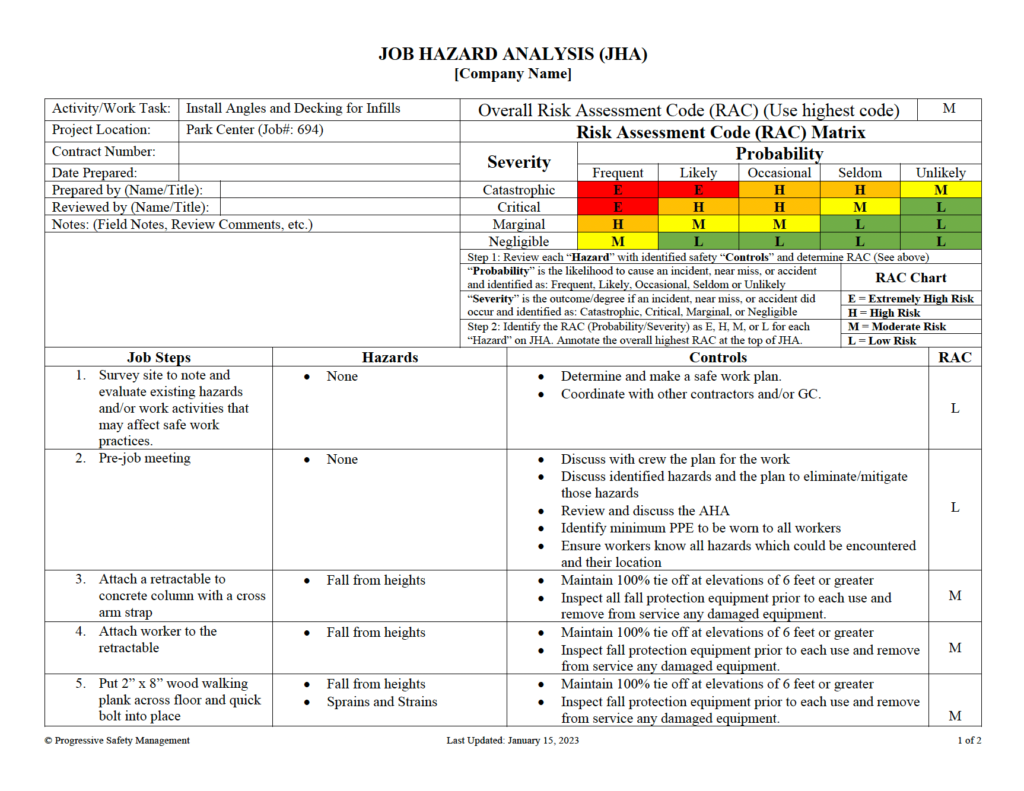
4.1 Risk Assessment Matrix
What It Is
A risk matrix is a visual tool used to rank risks based on likelihood and consequence.
Why It Matters
- Enables consistent risk ranking
- Supports decision-making and permit approvals
- Defines ALARP (As Low As Reasonably Practicable) thresholds
Typical Consequence Categories
- People (injury, fatality)
- Environment (spill volume, duration, sensitivity)
- Asset (equipment damage, downtime)
- Reputation (media, regulatory impact)
4.2 Job Hazard Analysis (JHA) / Job Safety Analysis (JSA)
Purpose
To break down a job into steps, identify hazards at each step, and define controls.
Common Applications
- Lifting operations
- Hot work
- Confined space entry
- Working at height
Best Practices
- Conducted by the work team
- Reviewed before starting work
- Updated when conditions change
In many companies, a valid JHA/JSA is mandatory for Permit to Work (PTW) approval.
4.3 Permit to Work (PTW) System
Role in Risk Management
The PTW system ensures that high-risk activities are:
- Properly assessed
- Authorized by competent persons
- Coordinated to prevent conflicting activities
Common Permit Types
- Hot Work Permit
- Cold Work Permit
- Confined Space Entry Permit
- Electrical Isolation Permit
PTW acts as a risk control and verification tool, not just a form.
4.4 Bow-Tie Analysis
What Is Bow-Tie Analysis?
A visual risk analysis tool that links:
- Threats → Top Event → Consequences
- Preventive and mitigative barriers
Why It’s Powerful
- Clearly shows how accidents happen
- Highlights barrier integrity and weaknesses
- Widely used for Major Accident Hazards (MAHs)
Bow-tie analysis is a core element of process safety management.
4.5 HAZID (Hazard Identification Study)
Purpose
A structured brainstorming technique used early in projects or operations to identify hazards.
When Used
- New facilities or modifications
- New operations or locations
Output
- Hazard register
- Recommended safeguards
- Action tracking
4.6 HAZOP (Hazard and Operability Study)
Scope
A detailed, systematic examination of process deviations using guide words such as:
- No
- More
- Less
- Reverse
Focus Areas
- Process safety
- Equipment integrity
- Human factors
HAZOP is critical for refineries, gas plants, and production facilities.
4.7 Quantitative Risk Assessment (QRA)
What Makes QRA Different
- Uses numerical data and modeling
- Calculates individual and societal risk
Applications
- Facility siting
- Offshore platform design
- Emergency planning zones
QRA supports high-level strategic decisions.
4.8 Incident Investigation & Root Cause Analysis
Why It Matters
Incidents are lagging indicators but provide powerful learning opportunities.
Common Tools
- 5 Whys
- Fishbone (Ishikawa) diagram
- TapRooT
- Tripod Beta
Effective investigations focus on system failures, not blame.
4.9 Management of Change (MoC)
Purpose
To ensure risks introduced by changes are identified and controlled.
Changes Covered
- Equipment
- Procedures
- Personnel
- Software or control systems
Many major oil and gas accidents have been linked to poorly managed change.
4.10 Emergency Risk Management & Response Planning
Key Elements
- Scenario-based emergency risk assessments
- Oil Spill Contingency Plans (OSCP)
- Fire and explosion response plans
- Medical and evacuation plans
Emergency preparedness ensures risk mitigation when prevention fails.
5. Integrating Risk Management into Daily Operations
Effective HSSE risk management is not paperwork—it is behaviour and culture driven.
Key Enablers
- Strong leadership commitment
- Workforce competence and training
- Stop Work Authority (SWA)
- Continuous safety communication
Frameworks such as Shell SEAM, API RP 75, and IOGP Life-Saving Rules emphasize frontline risk awareness.
6. Common Challenges in HSSE Risk Management
- Risk assessments treated as a formality
- Over-reliance on PPE instead of higher-level controls
- Poor quality JHAs copied from old jobs
- Weak barrier management
- Inadequate learning from incidents
7. Best Practices for Effective HSSE Risk Management
- Make risk visible – use simple, clear tools
- Involve the workforce – those doing the job know the risks best
- Focus on critical risks – especially MAHs
- Verify controls in the field – not just on paper
- Continuously improve – learn from near misses
8. Conclusion
Risk management in HSSE is the foundation of safe oil and gas operations. When applied correctly, tools such as risk matrices, JHA, PTW, bow-tie analysis, HAZOP, and MoC transform HSSE from a compliance exercise into a proactive risk-based culture.
In an industry where one failure can cost lives, devastate the environment, and cripple businesses, robust HSSE risk management is not just good practice—it is a moral, legal, and operational necessity.