
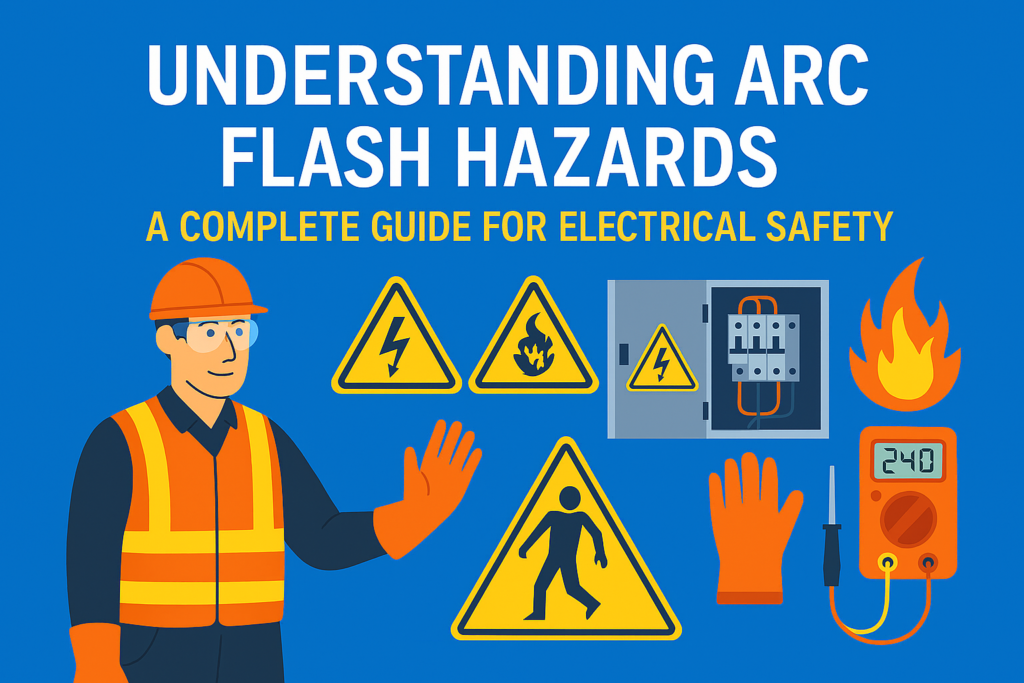
Arc flash is one of the most dangerous electrical hazards in industrial and commercial environments. It can cause severe injuries, equipment damage, and even fatalities within milliseconds. As an electrical safety expert, I’ll break down what arc flash is, why it occurs, and how to prevent it.
What Is an Arc Flash?
An arc flash is a sudden release of electrical energy through the air when a high-voltage gap exists and current flows through it. This event produces:
- Extreme heat: Up to 35,000°F (19,400°C)—hotter than the surface of the sun.
- Intense pressure wave: Can throw workers across rooms.
- Blinding light: Causes temporary or permanent vision damage.
- Molten metal and shrapnel: Ejected at high speed, causing burns and trauma.
Causes of Arc Flash
Arc flash incidents typically occur due to:
- Human error: Accidental contact with energized parts.
- Faulty equipment: Worn insulation, loose connections, or corrosion.
- Improper work practices: Working live without proper PPE or isolation.
- Environmental factors: Dust, moisture, and conductive contaminants.
- Dropped tools: Creating a short circuit between phases or to ground.
Arc Flash vs. Arc Blast
- Arc Flash: Heat and light energy release.
- Arc Blast: Pressure wave caused by rapid expansion of air and vaporized metal.
Both can occur simultaneously, making the hazard catastrophic.
Consequences of Arc Flash
- Severe burns: Third-degree burns within fractions of a second.
- Hearing damage: Pressure waves can rupture eardrums.
- Eye injuries: Retinal burns and blindness.
- Fatalities: Even at low voltages if energy levels are high.
- Equipment destruction: Switchgear, panels, and cables can be obliterated.
Arc Flash Hazard Analysis
Performing an arc flash study is essential for compliance and safety:
- Calculate incident energy: Measured in cal/cm² at working distance.
- Determine arc flash boundary: Distance where PPE is required.
- Label equipment: Indicate voltage, incident energy, and PPE category.
- Update single-line diagrams: Ensure accurate system representation.
Standards:
- NFPA 70E
- IEEE 1584
- OSHA regulations
Personal Protective Equipment (PPE)
Arc-rated PPE is non-negotiable:
- Arc-rated clothing: Flame-resistant, tested for arc exposure.
- Face shield and balaclava: Protect against heat and flying debris.
- Voltage-rated gloves: With leather protectors.
- Hearing protection: Ear plugs or muffs.
- Insulated tools: Reduce risk of accidental contact.
PPE categories are based on incident energy levels:
- Category 1: Minimum 4 cal/cm²
- Category 4: Up to 40 cal/cm²
Preventing Arc Flash
- De-energize before work: Follow Lockout/Tagout (LOTO) procedures.
- Verify zero energy: Test before touch.
- Maintain equipment: Tighten connections, replace worn parts.
- Use remote switching: Reduce exposure during energization.
- Training: Ensure workers understand hazards and procedures.
Emergency Response
If an arc flash occurs:
- Do NOT touch the victim until power is off.
- Call emergency services immediately.
- Provide first aid for burns and trauma.
- Administer CPR if trained and safe.
Key Takeaways
Arc flash hazards are preventable with:
- Proper risk assessment
- Arc flash studies
- PPE compliance
- Safe work practices
Downloadable Resource
Arc Flash Hazard Checklist (PDF)
A field‑ready checklist covering hazard identification, PPE, safe work practices, and emergency response. Ideal for toolbox talks and job planning.
- ✔ Hazard identification: labels, diagrams, backfeed, condition
- ✔ PPE: arc‑rated clothing, gloves, face shield/balaclava, hearing protection
- ✔ Safe work: LOTO, test‑before‑touch, boundaries, remote switching
- ✔ Emergency: power isolation, first aid for burns, call‑out and RCA
Promote Safety Awareness
👉 Shop Arc Flash Safety Gear and Awareness Apparel on Amazon